

New Zealand-Singapore research friendship tackles excess body fat
A friendship spanning two decades is driving an investigation into how insulin works and its impact on metabolic health – critical research that can help reduce the incidence of diabetes and tackle obesity by targeting the way fat is stored in the body.
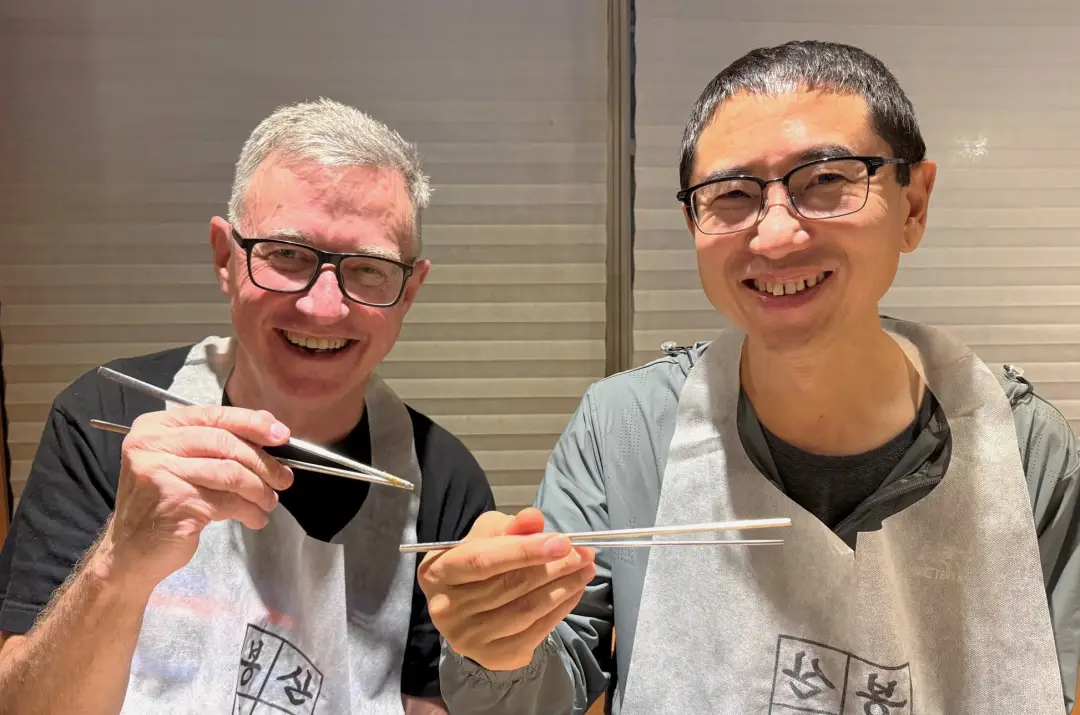
Professor Peter Shepherd of New Zealand and Professor Han Weiping of Singapore first met in 2006. They both credit their strong partnership for the significant progress they’ve made in understanding the fundamental underlying biology of how insulin works.
“So much relies on building trust and friendship,” says Peter, a professor in the molecular medicine and pathology department at the University of Auckland.
“Weiping and I share all sorts of insights and information. All of it is valuable towards the greater goal of creating better science.
“I’m very lucky to partner with someone like Weiping who is working for a common good rather than for personal gain.”
Weiping is the head of laboratory of Metabolic Medicine at A*STAR, Singapore’s lead public sector research and development agency. He says he and Peter are both motivated by the possibility of progress and discovery.
“The intention is to build scientific excellence together. There is a reciprocal aspect that is important. We’ve become good friends. When we meet, we share our best experience.”

Diabetes is a problem where you can’t handle glucose well and your body has a hard time clearing it from the bloodstream.
A kinase is a type of enzyme in the body. It transmits signals and regulates complex processes in cells, including the process to clear glucose.
“Insulin controls all the metabolism in our body. It does this by regulating the activity of an enzyme called PI3 kinase,” Weiping says.
“If this kinase doesn’t work well enough, it leads to diabetes. If it works too well, it can lead to cancer.”
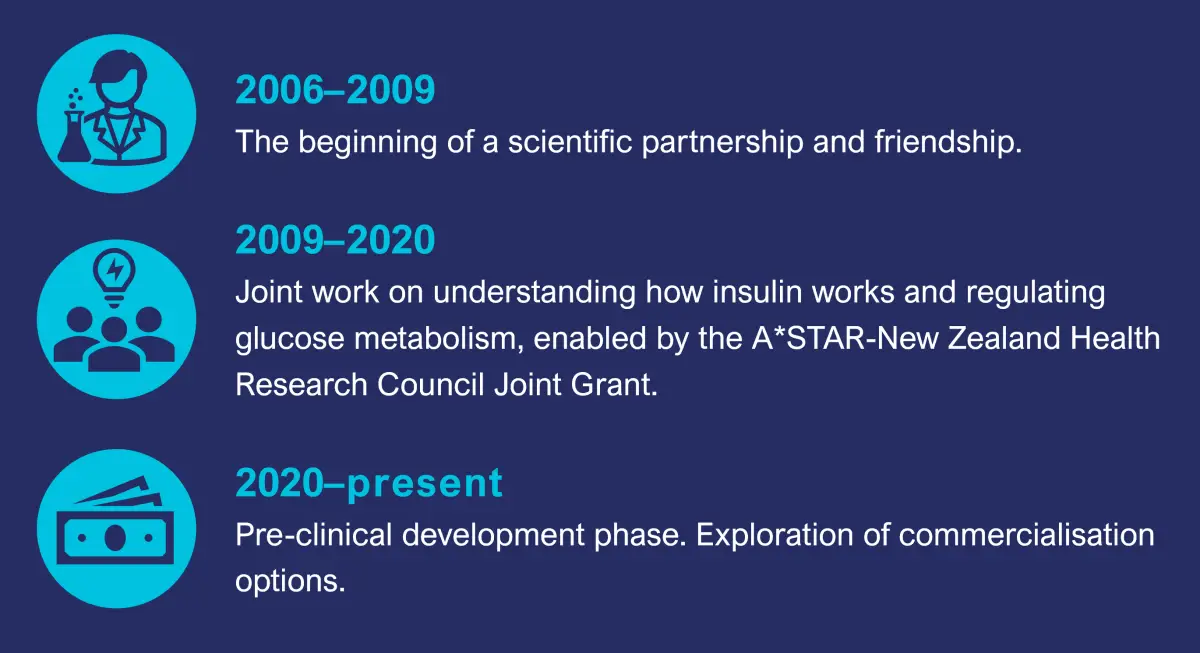
Peter and Weiping first met when they took part in a diabetes and obesity study group. In 2009 they were awarded an A*STAR-NZ Health Research Council joint grant to investigate the relative roles of kinases in regulating glucose metabolism.
“In the early 2000s, it was a whole new frontier,” Peter says.
“These new networks of scientists were developing across Asia that didn’t exist before.
“These regional networks are important. They provide opportunities. Many drugs are tested in America and Europe initially. But some things work differently for different populations, for example Asian populations.”
In 2009 Peter and Weiping published a joint paper in which they outlined their findings on how the PI3 kinase impacts how insulin works. The research provided clues that could help develop new ways of targeting obesity.
“That was a really good win,” Peter says.
The next step for the two friends will be to look for support from biotech business to nurture science collaboration and build startups. Unlike GLP-1 medications such as Wegovy that work by suppressing appetite, the treatment that the two researchers are developing would target the body's fat-storage process.
Weiping sees synergies between Singapore’s focus on biotech as a pillar of its economy, and New Zealand’s track record in developing drugs for diseases.
Peter agrees. “Singapore has strong resources, such as a generous government-backed funding mechanism to support asset development and spinoffs. Meanwhile New Zealand brings real advantages. We have a strong history in developing drugs for cancer and other diseases.
“As scientists, we tend to be purists. We want to understand the biology. But there is also the social responsibility side.
“Metabolic health rather than weight loss is the primary objective. At the same time, if we work in a research area like metabolism then it’s a natural shift to look at clinical practice and commercial success.”
As of 2026, the research is in the pre-clinical development phase. Peter and Weiping hope it will be trialled on humans in the next two or three years.