

Food and Beverage, Primary Products, Services:
On this page
Summary
Japan’s economy saw moderate growth, estimated at 1.1%, during the 2025 financial year (April 2025-March 2026). There were some positive signs. Private consumption and business investment were robust, and real wages grew in January and February 2026, breaking 13 months of consecutive declines. However, inflation over the same period was above target rates of 2%, with core consumer prices growing by 2.6%.
The impact of conflict in the Middle East has yet to fully emerge in economic data. The government has said it would keep a close eye on the impacts of the conflict on Japan’s economy, with concerns about a decline in consumer confidence. Economic growth projections have been revised downwards while inflation projections revised upwards.
Total exports from New Zealand to Japan grew by 4.4% on an annual basis for the year ending December 2025. More recent goods exports data for the year ending March 2026 saw lower growth, at only 0.46%. Dairy, horticulture, forestry, and food and beverage exports grew while aluminium, meat and fisheries exports declined. Services trade is recovering but remains below pre-pandemic levels, with tourist numbers at 76.7% of pre-pandemic levels.
Report
Economic outlook
For the 2025 financial year (April 2025-March 2026) Japan’s real GDP was estimated to have grown by 1.1%. Economic growth was supported by robust private consumption (1.3%) and growth in business investment (1.9%). Public consumption grew more slowly (0.1%).
The Cabinet Office, in its monthly economic update for April, commented that it assessed that Japan’s economy was recovering at a moderate pace. They were keeping a close watch on the impact of the conflict in the Middle East. In a change from the previous month’s assessment, the Cabinet Office noted that consumer confidence was weakening. More recent indicators for private consumption painted a mixed picture. Household appliance sales and hospitality spending were up, but new car sales and travel were down.
A positive development was that real wages increased, with January seeing the first rise in 13 months (1.4% for the year ending January 2026) which continued into February (rising to 1.9% for the year ending February 2026). Unemployment dropped in February by 0.1% to 2.6%.
The Cabinet Office commented that they were closely watching the impact of conflict in the Middle East on business sentiment. Capital investment was on the rise and expected to increase through the 2026 financial year according to the Bank of Japan’s March business survey. Corporate earnings were showing signs of improvement, although the Cabinet Office noted the impacts of US trade policy continued to be felt.
Housing construction was noted as an area of weakness by the Cabinet Office. The number of new housing units beginning construction fell in February 2026 by 0.6% compared to the previous month. More recently there have been reports of increased delays in construction projects due to material shortages caused by conflict in the Middle East. Various reports have emerged of construction material suppliers restricting orders and raising prices, including for waterproofing materials, adhesives, paint thinners, and insulation materials.
Core consumer prices remain above the Bank of Japan’s target of 2%, at 2.6% during the 2025 financial year. During the 2025 calendar year import prices fell, driven by oil and gas price decreases and exchange rate factors. Both of these factors have reversed sharply since conflict in the Middle East began, which is expected to drive up inflation. The Cabinet Office expects that consumer prices would continue to rise “gradually”.
The Bank of Japan decided to hold interest rates unchanged during their latest review on 28 April. The Bank of Japan last raised interest rates in December 2025 to 0.75%. Three of the nine-member Bank of Japan’s monetary policy board voted to increase interest rates given rising inflationary pressure exacerbated by conflict in the Middle East.
In holding interest rates unchanged the Bank of Japan assessed that the economy was growing moderately but this was expected to slow. Commentators assess that a future interest rate hike is more likely, particularly if current inflationary pressures persist.
The Bank of Japan cut its growth forecast for the 2026 financial year to 0.5%, from previous estimates of 1.0%. They also raised their core inflation outlook to 2.8%, from previous estimates of 1.9%. The Bank of Japan assessed that increased crude oil prices would put downwards pressure on corporate profits and real household incomes, as well as leading to deteriorating terms of trade.
International trade snapshot
Provisional statistics from the Ministry of Finance for the month of March showed an increase in exports of 11.7% compared to the same month last year, to JPY 11.0tril (NZD 117bn) while imports grew 10.9% to JPY 10.3tril (NZD 110bn). Notable trading relationships that saw fluctuations included:
- China – exports up 17.7% to JPY 2.0tril (NZD 21bn) and imports up 8.8% to 2.3tril (NZD 24.5bn).
- US – exports up 3.4% to JPY 1.9tril (NZD 20bn) and imports up 17.7% to JPY 1.2tril (NZD 13bn).
- Middle East – exports down 45.9% to JPY 226bil (NZD 2.4bn) and imports down 10.7% to JPY 879bil (NZD 9.4bn).
- ASEAN – exports up 19.7% to JPY 1.9tril (NZD 20bn) and imports up 10.6% to JPY 1.7tril (NZD 18bn)
Trade with New Zealand
For the year ending December 2025 two-way trade was NZD 9.2bn, with exports at NZD 4.72bn and imports at NZD 4.48bn. This represents a 4.4% increase in exports and a 1.5% reduction in imports compared to a year ago. Japan was New Zealand’s fifth largest trading partner and fourth largest export market during this period.
| New Zealand Goods Trade with Japan (NZD year to December 2025) | |||
|---|---|---|---|
| Total goods trade | $8.08bn | ||
| NZ exports | $4bn | NZ imports | $4.08bn |
| Main exports | Dairy Products; Fruits and Nuts; Aluminium; Meat and Edible Offal; Wood | Main imports | Vehicles; Mechanical Machinery; Mineral Fuels and Oils; Electrical Machinery |
Trade with Japan in total goods
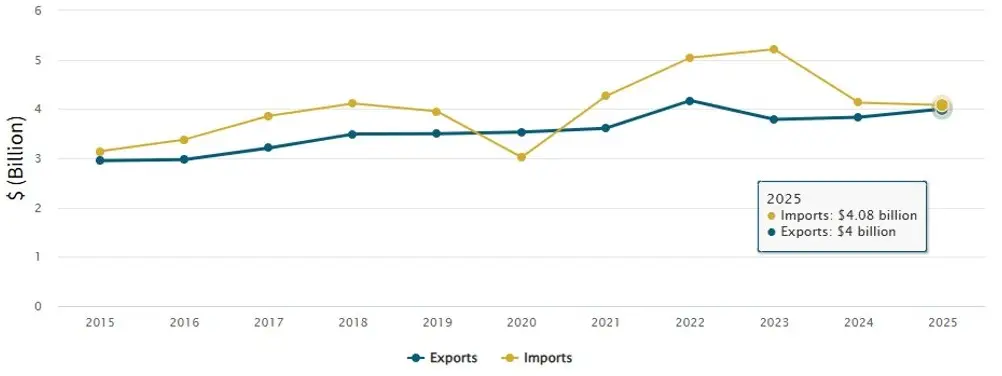
More recent goods exports data for the year ending March 2026 saw lower growth, at only 0.46%. Dairy, horticulture, forestry, and food and beverages exports grew while aluminium, meat and fisheries exports declined.
Goods imports from Japan over the same period saw a 5.71% increase over the same period, with increases in vehicle and machinery imports but a decline in fuel imports. On the latter, fuel imports fell on a value basis by 3.59% for the year ending March 2026, but there was significant variation in monthly import values likely reflecting shipment timings.
New Zealand Goods Exports to Japan by Industry: Year Ending March 2026
| Industry | Year ending March 2026 | ||
|---|---|---|---|
| $ Millions | % Change | % Share | |
| Dairy | 1,009 | 2.7 | 25.9 |
| Horticulture | 855 | 8.9 | 21.9 |
| Aluminium | 552 | -8.3 | 14.1 |
| Meat | 461 | -2.0 | 11.8 |
| Forestry | 310 | 0.8 | 7.9 |
| Miscellaneous food | 249 | 4.7 | 6.4 |
| Fish | 65 | -9.7 | 1.7 |
| Subtotal of leading industries | 3,501 | N/A | 89.7 |
| Other goods | 403 | N/A | 10.3 |
| Total | 3,904 | 0.46 | 100 |
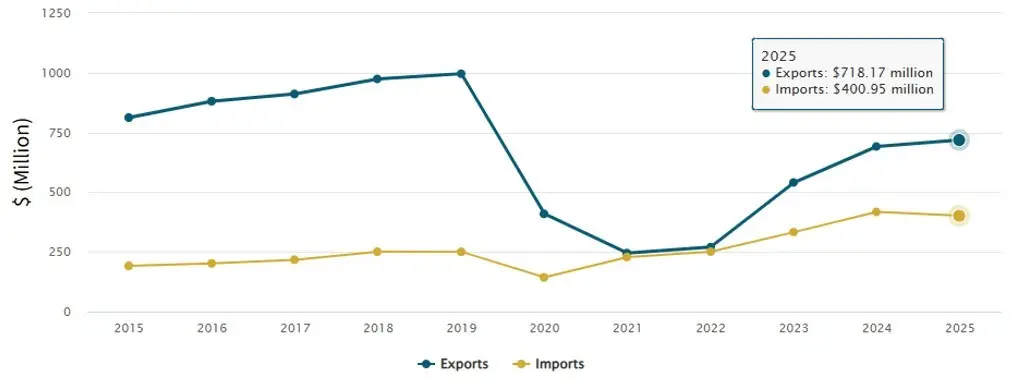
Services trade for the year ending December 2025 saw little change from the previous year. Tourism made up the bulk of services trade, with 74,812 visitors from Japan coming to New Zealand over this period. More recent figures for the year ending February 2026 are similar at 75,123. This represents a 76.7% recovery from pre-pandemic levels. The weak yen continues to dampen the demand for overseas travel from Japan.
| New Zealand Services Trade with Japan (NZD year to December 2025) | |||
|---|---|---|---|
| Total goods trade | $1.12bn | ||
| NZ exports | $718.17m | NZ imports | $400.95m |
| Main exports | Travel; Business Services; Telecommunications and Information Services; Government Services | Main imports | Travel; Business Services; Charges for Intellectual Property; Government Services; Insurance and pension services |
Trade with Japan in total services
More reports
View full list of market reports
If you would like to request a topic for reporting please email exports@mfat.govt.nz
Sign up for email alerts
To get email alerts when new reports are published, go to our subscription page(external link)
Learn more about exporting to this market
New Zealand Trade & Enterprise’s comprehensive market guides(external link) export regulations, business culture, market-entry strategies and more.
Disclaimer
This information released in this report aligns with the provisions of the Official Information Act 1982. The opinions and analysis expressed in this report are the author’s own and do not necessarily reflect the views or official policy position of the New Zealand Government. The Ministry of Foreign Affairs and Trade and the New Zealand Government take no responsibility for the accuracy of this report.
Copyright
Crown copyright ©. Website copyright statement is licensed under the Creative Commons Attribution 4.0 International licence(external link). In essence, you are free to copy, distribute and adapt the work, as long as you attribute the work to the Crown and abide by the other licence terms.