

Supply Chains, Creative and ICT:
On this page
Summary
- Malaysia recorded strong trade growth in the first half of 2026, with total trade expanding 22.4% year-on-year. Growth was overwhelmingly manufacturing-led, with electrical and electronic (E&E) products and other advanced manufacturing sectors driving a 27.5% increase in exports.
- The simultaneous expansion of manufactured exports and imports highlights Malaysia’s increasingly important role in regional and global production networks. Imports of machinery, electronic components and other industrial inputs are rising alongside exports, consistent with Malaysia’s role as a manufacturing and processing hub.
- Export growth remains closely linked to global technology demand. Stronger exports to the United States, Taiwan, Hong Kong and the European Union reflect continued demand for semiconductors, advanced electronics and AI-related infrastructure, while China remains Malaysia’s largest trading partner and an important source of manufacturing inputs.
- For New Zealand businesses, Malaysia combines an established market for agricultural products with growing opportunities in services and sectors supporting industrial upgrading. New Zealand retains strong market positions in dairy, day-old chicks, sheep meat and selected fruit, although competition is increasing in some segments.
- Malaysia’s continued investment in advanced manufacturing, data centres and technology infrastructure could create further opportunities for New Zealand businesses in specialised food ingredients, professional and engineering services, education, technology and other high-value solutions.
Report
Malaysia’s trade growth is increasingly manufacturing-led
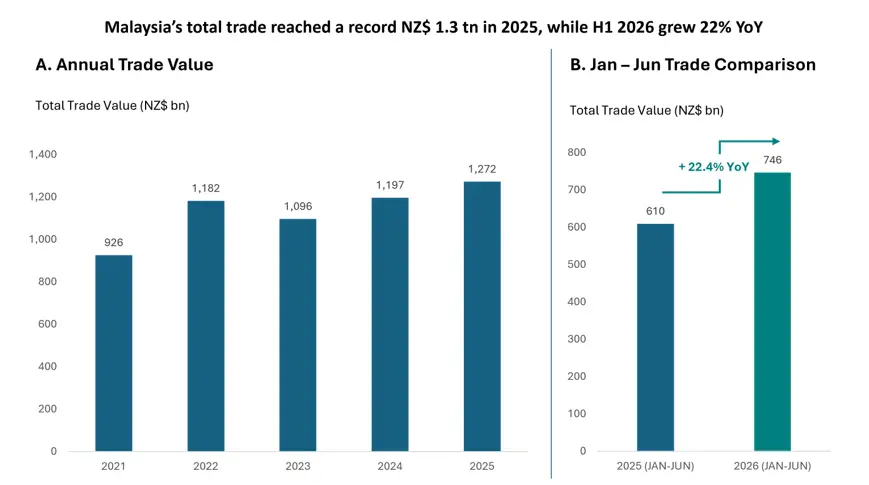
Malaysia's total trade expanded 22.4% year-on-year to NZ$ 746 billion during January-June 2026. Exports increased 27.5% to NZ$ 403.8 billion, comfortably outpacing imports, which rose 16.9% to NZ$ 342.6 billion. As a result, Malaysia's trade surplus almost tripled from NZ$ 23.5 billion to NZ$ 61.1 billion, indicating that export earnings more than offset the increase in imported production inputs.
Malaysia’s recent trade composition is being driven less by commodity cycles and increasingly by industrial production. Manufacturing accounted for 88.4% of exports and 87.6% of imports, while contributing almost the entirety of export growth during the first half of 2026. In contrast, agriculture contracted by 8.9%, largely due to weaker palm oil exports.
Electronics remain the engine, with growth spreading across advanced manufacturing
Electrical and electronic (E&E) products remained the principal driver of export growth, increasing 42.5% to NZ$ 194.5 billion and accounting for almost half of Malaysia's exports. Growth was not confined to electronics: optical and scientific equipment (+40.8%), petroleum products (+27.4%), manufactured metal products (+19.1%) and machinery and equipment (+12.6%) also recorded strong gains.
Imports increased strongly across many of the same sectors, including E&E products (+29.2%), petroleum products (+39.2%), machinery and equipment (+12.8%), optical and scientific equipment (+27.8%) and manufactured metal products (+16.7%). The parallel growth in imports and exports is consistent with Malaysia’s deep integration into cross-border production networks, where imported components, machinery and intermediate goods support export-oriented manufacturing.
Technology-driven export markets continue to outperform
Export growth was concentrated in markets closely integrated with global semiconductor and technology supply chains. Exports to Taiwan (+67%), Hong Kong (+49%), the United States (+55%) and the European Union (+29%) all recorded strong growth, reflecting continued demand for semiconductors, advanced electronics, and AI-related infrastructure. The United States remained Malaysia's largest export destination, accounting for 17.8% of total exports, followed by Singapore (13.8%) and China (11.0%).
China nevertheless remained Malaysia's largest overall trading partner and largest source of imports during the first half of 2026. Imports from China increased from NZ$67.4 billion in January–June 2025 to NZ$90.6 billion in January–June 2026 and accounted for more than one quarter of total imports.
Malaysia is positioned between Western demand and Asian supply chains
Current trade patterns suggest diversification rather than decoupling. Malaysia continues to benefit from strong demand from the United States while remaining deeply integrated with Chinese and regional supply chains. Malaysia's trade surplus with the United States widened from NZ$ 15 billion to NZ$ 46 billion during the first half of 2026 as exports expanded and imports declined. Malaysia’s established semiconductor and manufacturing base, broad network of trade agreements and links to major Asian supply chains position it as an attractive location for companies seeking to diversify regional production while retaining access to both Asian inputs and global export markets.
Malaysia remains outward-looking on trade and investment
Trade, investment, and industrial upgrading remain central to Malaysia’s economic strategy. The government continues to seek investment in higher-value manufacturing and technology while expanding economic partnerships and export markets. For businesses, this outward-looking approach reinforces Malaysia’s role as both a sizeable domestic market and a potential base for accessing wider Southeast Asian and global supply chains.
An established agricultural relationship remains a strong foundation
New Zealand-Malaysia bilateral trade recovered to NZ$4.58 billion in the year ended March 2026, matching the record level reached in 2023. New Zealand exports to Malaysia were NZ$1.82 billion, while imports from Malaysia reached NZ$2.76 billion. Malaysia remained New Zealand's tenth-largest overall trading partner.
New Zealand already has significant positions in several Malaysian food and agricultural markets. In 2025, New Zealand supplied 75% of Malaysia’s imports of day-old chicks. New Zealand also remained a leading dairy supplier, including around 73% of Malaysia’s butter imports. New Zealand was Malaysia’s second-largest supplier of sheep meat, with a 15% market share, while its share of selected fresh fruit imports increased from 8% in 2023 to 10% in 2025. These established positions demonstrate continuing Malaysian demand for high-quality New Zealand food and beverage products.
Competition is increasing in some established sectors
Strong existing positions do not guarantee future market share. New Zealand's overall share of selected Malaysian dairy imports declined from 47% in 2023 to 43% in 2025 as competition increased. New Zealand's share of frozen beef imports also declined from 2.4% to 1.2% over the same period. For New Zealand exporters, maintaining market access, strong commercial relationships and product differentiation will remain important in an increasingly competitive Malaysian food & beverage market.
The relationship is broadening beyond traditional goods trade
Malaysia's industrial development is also increasingly reflected in New Zealand's imports. While mineral fuels remain a major import category, imports of Malaysian mechanical machinery increased 48% between 2022 and 2026 and optical and scientific equipment increased 75%. Services are also becoming more important – New Zealand travel exports to Malaysia have more than quadrupled as international tourism recovered following the Covid-19 pandemic, illustrating scope for the relationship to expand beyond traditional merchandise trade.
Malaysia’s industrial upgrading creates new opportunities for New Zealand
Malaysia’s growth in semiconductors, data centres, high-value manufacturing and associated services creates opportunities for New Zealand companies beyond traditional primary-sector exports. Potential areas of alignment include specialised food and beverage ingredients, agritech, professional services, education and training, digital solutions and technologies that improve productivity and resource efficiency. For New Zealand firms looking at Southeast Asia, Malaysia also offers strong regional connectivity, modern infrastructure, strong English language skills, established commercial and legal infrastructure and access to wider ASEAN production networks.
Partnerships with Malaysian businesses can provide local market knowledge and potentially support expansion into neighbouring markets. Malaysia's combination of strong domestic demand, an increasingly sophisticated manufacturing base, relatively competitive operating costs, a comfortable living environment, and continued openness to international trade makes it a market worth closer consideration for New Zealand businesses seeking growth in Southeast Asia.
More reports
View full list of market reports(external link)
If you would like to request a topic for reporting please email exports@mfat.govt.nz
Sign up for email alerts
If you would like to subscribe to this weekly update, go to our subscription page(external link) or email us at exports@mfat.govt.nz
Feedback
We welcome feedback from New Zealand exporters on this report and invite requests for reporting from New Zealand’s network of Embassies and High Commissions(external link). If you have suggestions on a topic you would like to hear more about, or to subscribe to this weekly update, you can sign up here(external link) or email us at exports@mfat.govt.nz
External links
The following links may provide useful information to businesses:
NZTE’s website(external link) and their myNZTE(external link) provides a range of insights and tools available to support New Zealand exporters.
The Treasury releases a weekly economic update(external link) every Friday. Stats NZ has published a data portal(external link) with near real-time economic indicators.
MBIE publishes a sector reports series(external link) which provides regularly updated reports on all industry sectors that make up the New Zealand economy. These include official economic data and the challenges and opportunities that face New Zealand’s industry sectors.
Business.govt.nz(external link) provides tools and advice from across government to save small businesses’ time and help make the business a success.
MFAT has created a tariff finder(external link) which is designed to help goods exporters and importers maximise benefits from New Zealand’s Free Trade Agreements and compare tariffs in 136 other markets.
The all of government Trade Barriers(external link) website can be used to register any trade barriers experienced or issues exporting to an offshore market. Queries can be sent via the website or through the MFAT Exporter Helpline 0800 824 605. Enquiries will be sent to the government agency best placed to answer.
Tatauranga Aotearoa Stats NZ provides official data on the value of New Zealand’s exports and imports of both goods and services, by commodity type via the New Zealand Trade Dashboard(external link). This interactive dashboard is updated every quarter and allows for filtering by country and by commodity type.
Learn more about exporting
New Zealand Trade & Enterprise’s comprehensive market guides(external link) cover export regulations, business culture, market-entry strategies and more.
Disclaimer
This information released in this report aligns with the provisions of the Official Information Act 1982. The opinions and analysis expressed in this report are the author’s own and do not necessarily reflect the views or official policy position of the New Zealand Government. The Ministry of Foreign Affairs and Trade and the New Zealand Government take no responsibility for the accuracy of this report.
Copyright
Crown copyright ©. Website copyright statement is licensed under the Creative Commons Attribution 4.0 International licence(external link). In essence, you are free to copy, distribute and adapt the work, as long as you attribute the work to the Crown and abide by the other licence terms.