

Primary Products, Manufacturing (excludes F&B):
On this page
Executive summary
This survey was designed to capture on the ground experiences of NZ–Fiji traders and service providers, identifying non tariff barriers to trades (NTBs) that the New Zealand Government could work to mitigate or collaborate with the Fijian Government to mitigate.
Highlights:
- Respondents: 32 total
- Business location: 20 New Zealand; 11 Fiji; 1 “have not started business yet.”
- Business size: Medium (14), Large (9), Small (6), Micro (2), Individual contractor (1).
- Years active: >10 years (22), 5–10 years (5), 1–2 years (3), 3–4 years (1), <1 year (1).
- Top sectors (multi select): Processed food (9), Consumer goods (8), ICT (7), Construction (6), Agricultural goods (5), plus smaller counts for services and energy.
Most frequently raised issues:
- Growth constraints (top mentions): Market competition (12), Biosecurity concerns (7), Scarcity of specialised staff (6), Visa concerns for business travel (6), Air services/transport lines (4).
- Frequently raised NTBs:
- Communication frictions (lack of clear/prompt communication; inconsistent advice).
- Biosecurity requirements (and “unclear” biosecurity rules and guidelines).
- Shipping delays/inconsistencies.
- Visa access constraints for staff (Fiji- and NZ based).
- Inconsistent application of tariff rate quotas or rates (or both)
Respondents would like to see:
- Improved visa processes for business travel
- Clear biosecurity and labelling requirements, with efficient avenues for raising queries and short response times to queries.
- Enhanced communication both between and from government agencies to reduce wait times and better answer private sector asks
- Shipping reliability and connectivity challenges addressed and improved.
Based on the feedback received, tackling these issues will reduce costs, improve predictability, and unlock growth opportunities for firms operating across the NZ–Fiji corridor.
Who responded – major results and trends
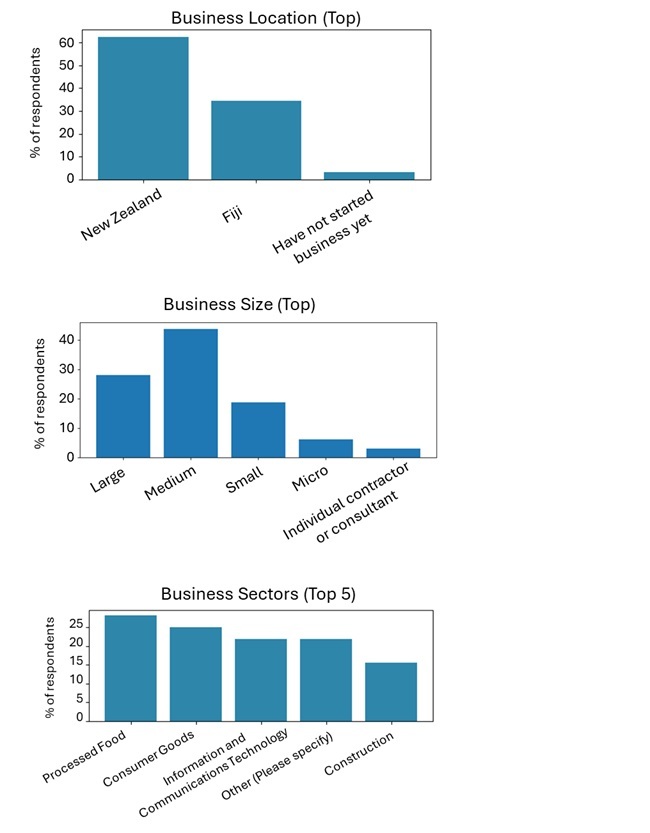
Insight: Most respondents are based in New Zealand, with medium and large firms dominating. Processed food and consumer goods narrowly lead sector representation, indicating strong fast moving consumer goods and agri-food trade links.
Trends by respondent characteristics
Trends by business location:
- Fiji‑based firms more often cite visa access for Fiji‑staff and shipping delays, plus communication gaps between agencies when submitting queries on a wide range of issues.
- NZ‑based firms more often point to unclear biosecurity requirements and a slow response time from officials when seeking clarification.
Trends in business size:
Medium and Large firms are the bulk of respondents; their top constraints mirror the overall list (competition, biosecurity, visa), with medium firms more frequently referencing communication frictions.
Trends in business sectors:
- Processed food & agricultural goods: biosecurity requirements, shipping delays, labelling/approval issues.
- ICT & services: scarcity of skilled staff, market competition, and communication predictability with agencies.
Trends in business origin/ownership:
- Fiji‑owned: visa access for Fiji‑based staff; shipping delays; communication gaps between agencies causing confusion and delayed response times.
- NZ‑owned: clarity/promptness of official communication; unclear biosecurity requirements; viable markets.
- Neither NZ nor Fiji ownership: tariff‑quota consistency, biosecurity, licensing and shipping.
- Joint/partial NZ–Fiji ownership: biosecurity requirements; viable markets; communication clarity.
Key constraints — major findings
- Visa processing and access constraints are a recurring friction for Fiji‑based staff and NZ travelers tied to service delivery.
- Biosecurity and product labelling approvals create frequent delays and added costs, particularly for processed food, agricultural goods, and consumer goods.
- Shipping reliability and limited air connectivity hinder timely market engagement and raise the total cost of getting goods from the producer to the consumer.
- Communication gaps with officials/settings (who is responsible; variable advice; response times) are common.
- Market competition and availability of skilled employees constrain growth for technological and services companies.
Key constraints — major themes
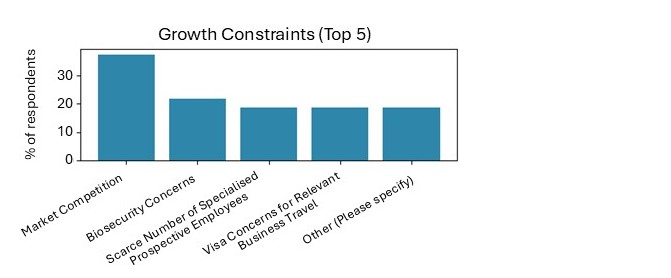
Insight: Market competition is the most cited growth constraint, followed by biosecurity and visa issues. These highlight structural and regulatory frictions impacting expansion.
Trade barriers — major themes
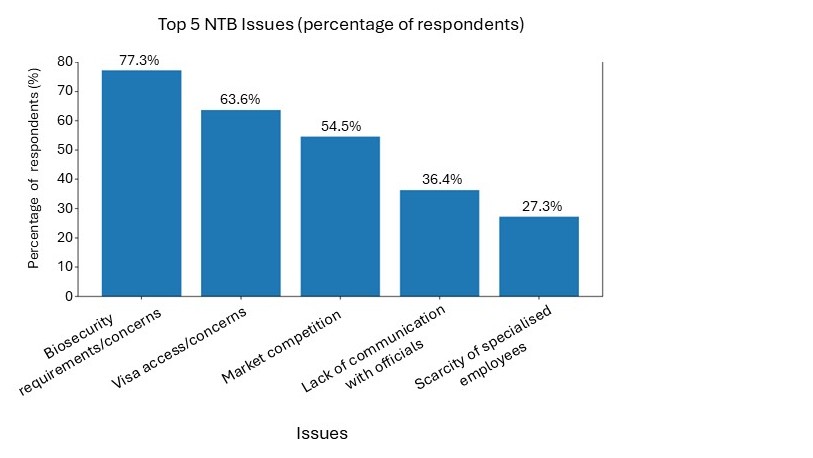
Insight: Communication gaps with officials and biosecurity requirements are the top NTBs. These issues suggest a need for clearer processes and better agency coordination.
What is working to promote trade
- NZTE/Trade Commissioner presence & missions — strong market connections and practical support.
- MFAT engagement and diplomatic facilitation such as trade missions and cross-agency collaboration.
- Immigration/visa changes and improvements in the digital/customs process.
- Trade agreements, with some respondents noting support for PACER Plus as well as existing agreements.
- Targeted business support and grants from Governments and non-governmental agencies.
What respondents feel should be prioritized areas of work
- Improve visa processing predictability, communication, and traveler access for Fiji–NZ business and service delivery.
- Create clearer, more consistent biosecurity and labelling pathways for food and agricultural products; avoid case‑by‑case resets.
- Enhance shipping reliability and explore air connectivity options that reduce time and cost between NZ and Suva/Nadi.
- Provide a single front‑door and clearer role delineation across MPI, Customs, and other agencies to avoid referral loops.
- Targeted sector skills and training pipelines for ICT, communications, and specialised services.
- Ensure tender transparency and predictable licensing/quota settings to reduce uncertainty.
More reports
View full list of market reports
If you would like to request a topic for reporting please email exports@mfat.govt.nz
Sign up for email alerts
To get email alerts when new reports are published, go to our subscription page(external link)
Learn more about exporting to this market
New Zealand Trade & Enterprise’s comprehensive market guides(external link) export regulations, business culture, market-entry strategies and more.
Disclaimer
This information released in this report aligns with the provisions of the Official Information Act 1982. The opinions and analysis expressed in this report are the author’s own and do not necessarily reflect the views or official policy position of the New Zealand Government. The Ministry of Foreign Affairs and Trade and the New Zealand Government take no responsibility for the accuracy of this report.
Copyright
Crown copyright ©. Website copyright statement is licensed under the Creative Commons Attribution 4.0 International licence(external link). In essence, you are free to copy, distribute and adapt the work, as long as you attribute the work to the Crown and abide by the other licence terms.