

Government:
On this page
Summary
The significant increase in Poland’s expenditure on defence and security presents opportunities for New Zealand companies, while in the context of prioritising partnerships that bring technology transfer, local manufacturing, and industrial know-how to Poland.
For a New Zealand company exploring the Polish market for the first time, the International Defence Industry Exhibition (MSPO), held annually in Kielce, is Poland's largest defence trade fair and offers a concentrated opportunity to meet counterparts, understand the competitive landscape, and identify potential partners. MSPO 2026(external link) is planned for 8-11 September.
You can also contact New Zealand Trade and Enterprise via myNZTE(external link) for support with international growth and market entry.
Poland is now NATO's highest defence spender as a percentage of GDP. In 2026, defence expenditure will be close to 5% of GDP ($US55 billion) with total planned expenditure of US475 billion over the decade 2025-2035.
Polish investment priorities span air and counter-drone defence, land forces modernisation, ammunition self-sufficiency, air power, naval capability rebuilding, and the fortification of the eastern border under the Tarcza Wschód (East Shield) programme. Artificial intelligence, autonomous systems and dual-use infrastructure feature prominently across these programmes. Civil protection is scaling up in parallel, with a projected multi-billion euro spend on shelters, logistics stockpiles and a new Civil Defence Corps.
Poland offers strong support for defence companies that want to set up production in Poland or supply technology and equipment to the Polish Armed Forces. Companies can access a range of incentives, including tax benefits, grants, loans, guarantees and funding from national and European programmes such as the European Investment Bank, European Defence Fund and European Defence Agency. The Polish Government has also streamlined approval processes for strategically important defence projects, and practical assistance is available from the Polish Investment and Trade Agency (PAIH), which provides support with site selection, partner identification, government engagement, funding opportunities and investment facilitation for defence and dual-use projects.
Report
A nation rearming
Given its location on NATO’s eastern flank, Russia’s war against Ukraine, and concerns about the long-term US military presence in Europe, Poland has embarked on an unprecedented military modernisation programme. National security now sits at the centre of state policy.
Poland will adopt a “Defence Industry Development Strategy” for 2026-2030 which is expected to envisage record spending and concrete steps toward a militarily strong state: rebuilding domestic industrial capacity, ‘re-polonizing’ (i.e. shifting a larger share of defence manufacturing and decision-making to Polish-owned entities) defence production, and reducing dependence on foreign suppliers. As noted below, Warsaw is prioritising partnerships that bring technology transfer, local manufacturing, and industrial know-how to Poland. The government has promised investment worth billions of zloty in Polish manufacturing [1]. Security and the growth of domestic production capability are now national priorities.
Civil protection is another core spend. The new “Programme for Civil Protection and Civil Defence 2025-2026” commits close to PLN34 billion (~US$9 billion) to shelters and emergency stockpiles to support a new Civil Defence Corps.
Poland: 13th largest defence spender
Russia's full-scale invasion of Ukraine drove a step change in Poland’s defence spending. Prior to 2023 it was increasing on average 9% per year. 2023 saw an almost 72% rise, to US$26.3 billion. In 2024, Poland became the world's 13th-largest defence spender, with expenditure reaching US$38 billion (a further 44% increase).
According to the NATO Secretary General's annual report, Poland's 2025 defence expenditure reached PLN166.2 billion, equivalent to roughly US$45 billion, and 4.3% of GDP, the highest ratio in the entire Alliance.
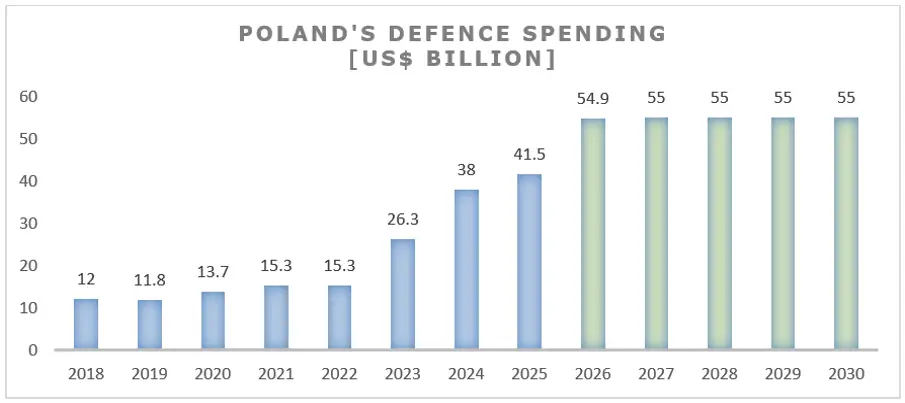
This year, the government lifted defence spending to around 4.8% of GDP, close to its stated ambition of 5%, and earmarked a record PLN200 billion (about US$53 billion) for defence. Poland's stated strategic goal is to hold spending at roughly 5% of GDP through the next decade which, depending on GDP growth and inflation, implies annual outlays upward of US$55 billion for 2026-2030.
Deloitte's report Poland's Investment in Defence: Military Buildup and Seeking Efficiencies in Working Towards Targets(external link) estimates that cumulative defence expenditure in 2025-2035 will reach approximately PLN1.9 trillion (~US$475 billion), more than double the PLN825 billion (~US$222 billion) spent in 2014-2024, with the implied shares split at about 38.7% for personnel, 26.9% for equipment and R&D, 5.9% for infrastructure, and 28.6% for maintenance and other costs.
Financing sources
Poland’s ambitious defence spending is financed through a combination of state-budget allocations and an off-budget Armed Forces Support Fund, which together provide the core, recurring funding for procurement, maintenance, and capability development. In parallel, Poland is drawing on additional resources via the EU’s Security Action for Europe (SAFE) instrument, a large-scale loan facility that supplements the baseline path by financing extra projects and industrial investments. The SAFE instrument and its implications for Poland are presented in the report Poland: Knocking on the Door of the G20(external link).
Poland’s Defence Investment priorities
Drawing on public sources and statements from the Ministry of National Defence and government officials, several priority investment directions stand out for the coming years.
Air and counter-drone defence. Layered air defence, combining long- and medium-range systems, is a clear priority, reinforced by lessons from the war in Ukraine and the growing threat from drones and cruise missiles. Poland is also investing in its own counter-drone capability; jam-resistant reconnaissance drones are among the country's export successes.
Land forces modernisation. Poland is expanding its inventory of tanks, infantry fighting vehicles and artillery, both through continued foreign procurement and through domestic production.
Ammunition and production self-sufficiency. The war in Ukraine has underlined the importance of stable, large-scale domestic production. Poland is expanding capacity for small-calibre and artillery ammunition, while also increasing output of guided systems such as the domestically produced Piorun missile.
Air power. While investment in the F 16, F 35, and helicopter fleets remains a priority, Poland’s growing focus on UAVs, space, and satellite capabilities opens new avenues for cooperation with foreign partners.
Naval capability rebuilding. Poland is working to acquire new submarines and build modern frigates for the Polish Navy in cooperation with domestic shipyards, alongside developing mine-countermeasure capability and protection for undersea infrastructure such as cables and pipelines.
Infrastructure, logistics and command systems. This includes fortifications, terrain obstacles, shelters and strongpoints along the eastern border under the East Shield programme (a national initiative, launched in 2024 with a budget of roughly PLN10 billion; ~US$2.5 billion), to fortify Poland's borders with Belarus and Kaliningrad through physical barriers, AI-enabled surveillance and dual-use infrastructure. It also covers new training grounds, logistics bases and ammunition depots, particularly near the border, along with investment in cyber defence, resilience to hybrid threats, and protection of critical infrastructure.
Civil defence. Shelter construction, dual-use technologies, and supporting road infrastructure round out the priority list, reflecting the growing convergence between military and civil protection planning.
Across these areas, Poland's goal is not merely to procure equipment but to produce more of it domestically. To that end, Warsaw is prioritising partnerships that bring technology transfer, local manufacturing, and industrial know-how to Poland. Existing examples include the K2PL tank programme with Hyundai Rotem(external link) and K9 howitzer cooperation with Hanwha Aerospace(external link) (Republic of Korea), the Homar rocket artillery system with Lockheed Martin(external link) (US), the Narew air-defence programme with MBDA(external link) (multinational European Group), and the Miecznik frigate programme with Babcock(external link) (British) and Polish shipyards. Together, these projects reflect Poland's broader strategy of building sovereign production capacity also through collaboration with foreign partners.
Opportunities for New Zealand
New Zealand companies are well placed to partner with Poland
New Zealand defence companies are well positioned to partner with Poland, reflecting a growing convergence of strategic, political and economic interests. As one of NATO's Indo-Pacific partners, New Zealand shares Poland's commitment to international security and has taken a similarly principled stance in support of Ukraine, providing a strong foundation for closer cooperation.
Bilateral defence engagement has intensified in recent years, particularly due to the NZDF deployment to Poland to train Ukrainian troops. This Government-led momentum is increasingly being matched by growing interest from New Zealand's private sector, with both countries identifying defence and aerospace, cybersecurity, advanced manufacturing, and dual-use technologies as areas of mutual interest.
The EU–New Zealand Free Trade Agreement further enhances the attractiveness of such partnerships by reducing trade barriers and improving market access. For New Zealand companies, Poland offers not only opportunities in one of Europe's fastest-growing defence markets, but also a platform for reaching the wider EU Single Market.
Investment advantages for defence companies investing in Poland
As defence has become a strategic priority for the Polish Government, the country has developed a highly supportive ecosystem for investors. Companies operating in the defence sector can access a wide range of support instruments at both the national and European levels, including tax incentives, government grants, loans, guarantees, and financing from EU institutions and programmes such as the European Investment Bank, the European Defence Fund, and the European Defence Agency.
Poland has also introduced dedicated legislation to accelerate strategically important defence and security investments. The framework establishes simplified procedures for planning and implementing projects deemed critical to national defence or public security, including the creation of protected and restricted zones where necessary. By replacing multiple administrative approvals with a single decision covering location, land acquisition, and key permit requirements, the legislation can reduce the duration of preparatory procedures by as much as 70%.
Beyond sector-specific incentives, Poland offers one of the most attractive investment environments in Central and Eastern Europe. Investors benefit from a combination of strong economic growth, a strategic location at the heart of Europe, well-developed transport and logistics infrastructure, and a highly skilled workforce. These advantages are explored in greater detail in the reports Why Poland? Opportunities for New Zealand Exporters(external link) and Poland: Knocking on the door of the G20(external link)
Where to start?
Attend MSPO
The International Defence Industry Exhibition (MSPO), held annually in Kielce, is Poland's largest defence trade fair and a focal point for the country's entire defence ecosystem. Government officials, the armed forces, domestic manufacturers and international suppliers all attend. MSPO 2026(external link) is planned for 8-11 September.
For a New Zealand company exploring the Polish market for the first time, MSPO is an ideal low-commitment starting point: it offers a concentrated opportunity to meet counterparts, understand the competitive landscape, and identify potential partners, before committing to the cost and effort of exhibiting.
Consult Polish Defence Sector Entrepreneur Portal
This knowledge-sharing portal(external link) covers the Polish defence sector and dual-use goods, along with the companies operating in these industries. Its business database allows foreign firms to identify suitable suppliers and business partners among 274 listed companies, with content available in six languages. In cooperation with the National Security Bureau (BBN), the portal also publishes the annual Polish Defence and Security Equipment Catalogue. Companies wishing to join the database or update their listing can contact: contact@polishdefenceindustry.gov.pl.
Explore the Industrial Cooperation Portal for Army Modernisation.
The Ministry of National Defence has recently launched a dedicated cooperation platform for companies developing technologies that support the modernisation and operational capabilities of the Polish Armed Forces. The portal includes a specific form for entrepreneurs(external link) through which companies can submit cooperation proposals directly. The Ministry reserves the right to follow up only with entities whose proposals are judged particularly relevant to the Polish Armed Forces' needs, so a clear, well-targeted submission matters.
Consult Polish Investment and Trade Agency and New Zealand Trade and Enterprise
The Polish Investment and Trade Agency(external link) (PAIH) is Poland's national investment promotion agency, helping foreign companies navigate the Polish market, connect with the right partners, and access available public support. Since 2025, PAIH's mandate has been extended to include dual-use and defence-related projects. Building on its existing, well-proven approach to attracting investment, the agency has adapted its instruments and procedures to the specific needs of the defence and dual-use sector, updated its internal regulations to enable the full handling of such projects, and appointed a dedicated Plenipotentiary (special representative) for Defence and Dual-Use Affairs.
PAIH's offer for foreign investors includes:
- Location consulting
- Tailor-made macroeconomic, HR, legal and sectoral data packs
- Support in building partnerships with R&D institutions and innovation centres
- Organisation of site visits for prospective investors
- Identification of potential business partners and suppliers
- Facilitating contacts with local and central government
- Information about different forms of public funding
- Introductions to startups and technology providers, and B2B meetings
- Follow-up services after project completion, including media relations aftercare
You can also contact New Zealand Trade and Enterprise via myNZTE(external link) for support with international growth and market entry.
Poland’s defence industry
Key figures
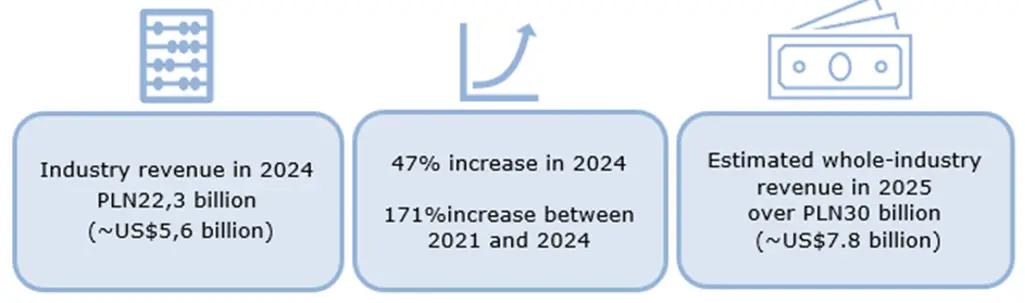
In 2024, Poland's defence industry recorded revenue of nearly PLN22.3 billion (~US$5.6 billion), up 47% on the previous year. Since 2021, sector revenue has grown by 171%, nearly 2.7 times, an average annual growth rate of around 39%. Full-year 2025 results for the sector as a whole have not yet been published, but the two largest players, PGZ and Grupa WB (described below), together generated an estimated PLN25 billion (~US$6.6 billion) in revenue in 2025. On that basis, analysts estimate that the whole industry likely exceeded PLN30 billion (~ US$8 billion) for the year.
Key players
Poland's defence industry comprises more than 140 companies. The dominant player is the Polish Armaments Group(external link) (Grupa Kapitałowa Polska Grupa Zbrojeniowa, PGZ), a state-owned holding encompassing roughly 60 companies, including the parent entity PGZ S.A. itself. PGZ accounts for around half of total sector revenue and occupies a similarly dominant position in major domestic procurement programmes. PGZ's revenue is projected to reach approximately PLN20 billion (US$5.3 billion) in 2025, more than 40% above the previous year's level and over three times its 2021 revenue. Net profit is expected to reach around PLN2.5 billion (US$670 million), with exports contributing approximately PLN1.9 billion (US$500 million).
The largest domestic private player is WB Group(external link) (Grupa WB), which specialises in unmanned systems, electronics, communications and loitering munitions. WB Group's revenue is projected to reach around PLN4.3–4.8 billion (approximately US$1.1–1.2 billion) in 2025, representing an increase of more than 40% year on year and roughly twelve times its 2021 level. Nearly 40% of the group's revenue comes from exports, including its FlyEye reconnaissance drones and Warmate loitering munitions, both of which have seen extensive use in Ukraine. The remainder of the private sector, a mix of foreign-owned entities and smaller Polish firms, accounts for the balance of industry revenue, with a number of small and medium-sized enterprises recording exceptionally rapid growth in recent years.
Poland's flagship domestic products, including the Krab self-propelled howitzer, the Piorun man-portable air-defence missile, and the Borsuk infantry fighting vehicle, are all developed through close cooperation between the state-owned and private sectors, illustrating how the two increasingly function as an integrated industrial ecosystem rather than separate tracks.
Defence industry 4.0
Poland's defence sector is increasingly shaped by what industry observers describe as "Defence Industry 4.0”, the application of artificial intelligence, automation and advanced sensor fusion to both military capabilities and manufacturing processes. The East Shield programme is one of the clearest examples, combining imagery, signals and acoustic intelligence with advanced surveillance and command systems to improve situational awareness along Poland's eastern border. PGZ is also developing a dedicated strategy for aerial, ground and maritime unmanned systems. On the industrial side, defence companies are investing heavily in digitalisation, automation and advanced manufacturing technologies to meet a scale of procurement and production not seen in Poland for decades.
Dual-use technologies
Dual-use infrastructure is becoming a deliberate policy priority rather than an incidental by-product of defence investment. The East Shield itself is being designed around dual-use principles: roads, bridges and logistics assets built to support military mobility will also serve local communities and civilian traffic. The Programme for Civil Protection and Civil Defence likewise finances shelters, roads and airfields intended for both civilian and military use. In parallel, the mandate of the Polish Investment and Trade Agency (PAIH), discussed further below, now explicitly encompasses dual-use investment projects.
[1] (Polish zloty:US dollar exchange rates at 1 September 2026 were 1:0.26).
More reports
View full list of market reports
If you would like to request a topic for reporting please email exports@mfat.govt.nz
Sign up for email alerts
If you would like to subscribe to this weekly update, go to our subscription page(external link) or email us at exports@mfat.govt.nz
Feedback
We welcome feedback from New Zealand exporters on this report and invite requests for reporting from New Zealand’s network of Embassies and High Commissions. If you have suggestions on a topic you would like to hear more about, or to subscribe to this weekly update, you can sign up here(external link) or email us at exports@mfat.govt.nz
External links
The following links may provide useful information to businesses:
NZTE’s website(external link) and their myNZTE(external link) provides a range of insights and tools available to support New Zealand exporters.
The Treasury releases a weekly economic update(external link) every Friday. Stats NZ has published a data portal(external link) with near real-time economic indicators.
MBIE publishes a sector reports series(external link) which provides regularly updated reports on all industry sectors that make up the New Zealand economy. These include official economic data and the challenges and opportunities that face New Zealand’s industry sectors.
Business.govt.nz(external link) provides tools and advice from across government to save small businesses’ time and help make the business a success.
MFAT has created a tariff finder(external link) which is designed to help goods exporters and importers maximise benefits from New Zealand’s Free Trade Agreements and compare tariffs in 136 other markets.
The all of government Trade Barriers(external link) website can be used to register any trade barriers experienced or issues exporting to an offshore market. Queries can be sent via the website or through the MFAT Exporter Helpline 0800 824 605. Enquiries will be sent to the government agency best placed to answer.
Tatauranga Aotearoa Stats NZ provides official data on the value of New Zealand’s exports and imports of both goods and services, by commodity type via the New Zealand Trade Dashboard(external link). This interactive dashboard is updated every quarter and allows for filtering by country and by commodity type.
Learn more about exporting
New Zealand Trade & Enterprise’s comprehensive market guides(external link) cover export regulations, business culture, market-entry strategies and more.
Disclaimer
This information released in this report aligns with the provisions of the Official Information Act 1982. The opinions and analysis expressed in this report are the author’s own and do not necessarily reflect the views or official policy position of the New Zealand Government. The Ministry of Foreign Affairs and Trade and the New Zealand Government take no responsibility for the accuracy of this report.
Copyright
Crown copyright ©. Website copyright statement is licensed under the Creative Commons Attribution 4.0 International licence(external link). In essence, you are free to copy, distribute and adapt the work, as long as you attribute the work to the Crown and abide by the other licence terms.