

Primary Products, Services, Government:
On this page
Summary
Poland remained one of the fastest growing economies in the EU in 2025. GDP growth reached approximately 3.6% in real terms, supported by consumption and EU-funded investment. For the first time in history, Poland's nominal GDP surpassed US$1 trillion. Early 2026 projections suggested Poland could enter the global top 20 economies, sparking debate about G20 membership. Revised IMF data postponed the milestone. Nevertheless, Poland was invited to the 2026 G20 summit. According to Statistics Poland, the average consumer inflation stood at 3.6%, while unemployment remained low at about 5%, coupled with steady wage growth, indicating a balanced macroeconomic environment and favourable medium-term outlook.
Poland’s trade volumes continued to grow in 2025, though the balance turned slightly negative. Trade with New Zealand expanded following the EU–NZ FTA, with bilateral flows increasing by 19%, indicating potential for further cooperation. Clean technology, agri-tech, consumer products, and business services remain strong growth areas, but defence, cybersecurity, dual-use technologies, and civil resilience infrastructure have rapidly moved to centre stage.
Poland offers a compelling mix of incentives, skilled workforce, and strategic location at the crossroads of the EU and Eastern markets, including Ukraine. Government support, EU funding, and a strong policy focus on economic resilience continue to enhance its appeal for foreign investors.
Report
Macroeconomic overview
Poland is a mature, diversified economy and the undisputed economic leader of Central and Eastern Europe. Over recent years the country has delivered stable growth. Despite substantial headwinds, Russia's ongoing war in Ukraine, persistent energy market volatility, and broader geopolitical uncertainty, the Polish economy has demonstrated resilience and an ability to adapt.
The National Bank of Poland (NBP) assesses that the outlook for 2026 is positive. The main growth catalysts are the EU funds under the 2021–2027 financial framework, the National Recovery and Resilience Plan (NRP), and the new SAFE defence programme, all of which are channelling large volumes of public investment into the economy, creating the conditions for rising household incomes, stronger business investment, and enhanced risk appetite across the private sector.
Gross Domestic Product
Poland has tripled its GDP over the past two decades, a transformation that began when the country joined the European Union in 2004. It remains the sixth largest economy within the Union, and its role as the regional anchor in Central and Eastern Europe continues to strengthen.
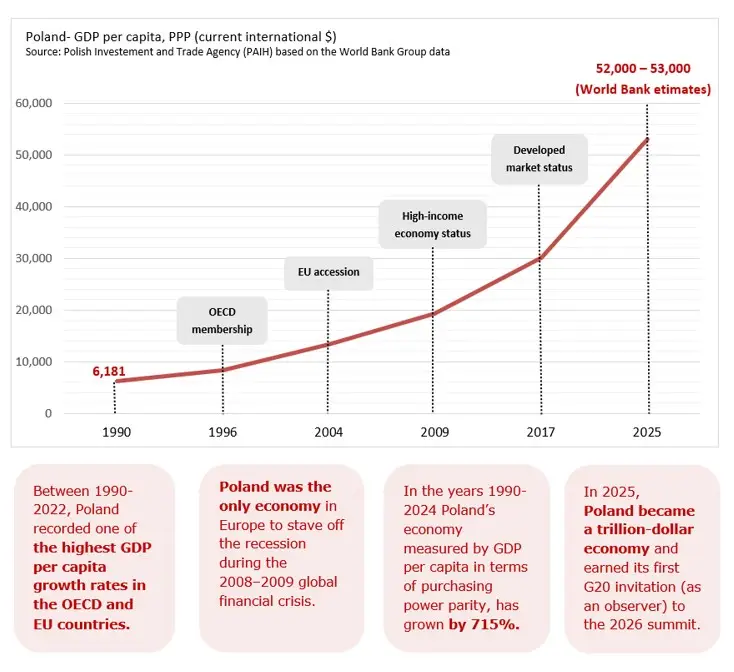
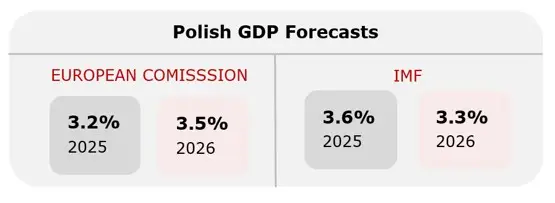
According to preliminary estimates published by Statistics Poland (GUS), real GDP expanded by 3.6% in 2025: the highest growth rate since 2022 and significantly exceeding the EU average of around 1.6%. Growth was driven primarily by private consumption, with public consumption and investment also contributing, supported by higher public spending and stronger absorption of EU funds.
G20 membership
In late 2025, the IMF’s World Economic Outlook suggested that Poland’s GDP could reach approximately US$1.04 trillion by year-end, potentially surpassing Switzerland and placing Poland among the world’s top 20 economies. However, the IMF's subsequent data revision placed Poland's final 2025 GDP at US$1.036 trillion and confirmed that Switzerland remained marginally ahead. The IMF projects Poland will surpass Switzerland in 2028 and continue growing faster through to the end of the decade.
Despite the revised ranking, Polish finance minister Andrzej Domański stated clearly that the revision does not alter Poland's ambition for full G20 membership. This year, Poland was invited by the US to attend the G20 summit as a guest. Poland's attendance marks the first time any Central or Eastern European country has been invited to a G20 leaders' summit.
Consumer Price Index and inflation
Consumer price dynamics in Poland shifted considerably between 2022 and 2025. The immediate aftermath of Russia's invasion of Ukraine in 2022 sent inflation surging to 17–18%, driven by energy price spikes, supply chain disruptions, and post-pandemic pressures. This was followed by a sharp decline in 2023, when inflation fell to about 6%. In 2024, inflation stabilised at a lower level, fluctuating between roughly 3.5% and 4.5%. For the full year 2025, GUS reported average annual inflation of 3.6%, closer to the National Bank of Poland's (NBP) target of 2.5% (with a tolerance band of ±1 percentage point). According to the NBP’s March projections, inflation will fall to approximately 2.4% in 2026 and 2.3% in 2027.
Currency
Poland maintains the zloty (PLN), a sovereign (non-Eurozone) currency. There is no likelihood of Poland joining the Eurozone. Polish President Karol Nawrocki has been clear that Poland will not adopt the euro. The zloty is stable against the euro and the US dollar.
Employment and salaries
Poland’s labour market remains highly competitive, with unemployment at around 5% in 2025 (one of the lowest rates in the European Union). This has driven wage growth. National average gross monthly wages reached approximately 9,000–9,500 PLN in 2025 (~€2,100–2,200) representing a year-on-year increase of 6–8%. In Poland's major business hubs (Warsaw, Kraków, Wrocław, and Gdańsk) salaries run 15–25% above the national average, particularly in information technology, engineering, financial services, and the shared services sector, where competition for skilled talent is most intense. Despite this wage growth, Poland continues to offer a strong price-performance ratio relative to Western European markets, making it one of the EU's most cost-competitive locations for knowledge-intensive operations.
Sovereign credit ratings
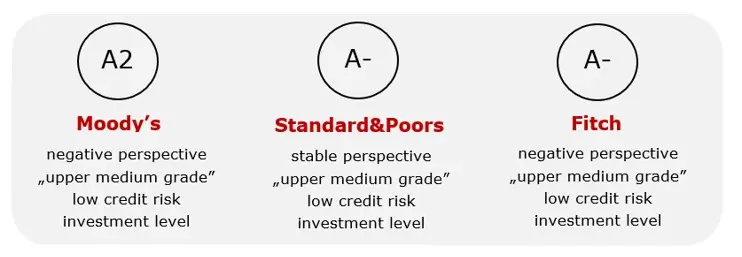
Poland's sovereign creditworthiness is assessed as investment-grade and resilient by all three major credit rating agencies. Moody's maintains a rating of A2, S&P rates Poland at A–, and Fitch likewise assigns an A– rating.
The outlook picture has become more nuanced since late 2025. While S&P continues to assign a stable outlook, both Moody's and Fitch revised their outlooks to negative during 2025 citing a general government deficit well above the A-rated peer median, public debt approaching 65% of GDP and warning that political tensions between the Government and President could complicate the fiscal consolidation needed to put debt on a downward path.
Finance Minister Domański acknowledged these revisions as a warning signal, while noting that Poland's strong underlying growth fundamentals, NATO and EU membership, continue to underpin the core ratings. Poland’s fiscal consolidation plan is in preparation.
International trade – snapshot
Poland's trade performance in 2025 reflected both the resilience of its export base and the pressures imposed by a challenging global environment. Total exports reached €366.2 billion (a year-on-year increase of 3.7%), while imports grew more rapidly to €373.9 billion (+6.1%), producing a negative trade balance of €7.7 billion, compared with a positive balance of €0.5 billion in 2024.
Despite the US tariffs introduced in 2025, Polish exports to the United States declined by only 0.1%. This limited impact was largely the result of front-loading by American importers.
Germany remains Poland's most important trading partner, though its share of Polish exports slipped slightly below 27% as Polish exporters diversified into other markets.
Meanwhile, China's share of Polish imports rose from 14.5% to 15.5%, with total import value from China expanding by over 13% year-on-year – a shift driven significantly by the rapid growth in Chinese car imports, which accounted for approximately 10% of the total increase in import value.
Poland – New Zealand trade
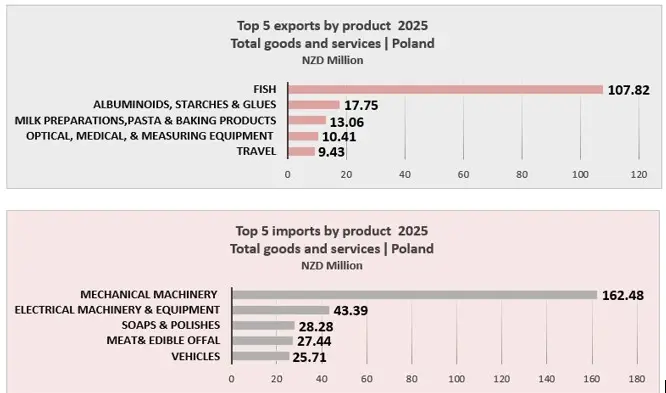
Trade between Poland and New Zealand expanded noticeably between 2023 and 2025, aided by the entry into force of the EU–New Zealand Free Trade Agreement (FTA) on 1 May 2024. New Zealand's exports to Poland grew from NZ$180.5 million in 2023 to NZ$215.7 million in 2025, (up 19.5%). Polish exports to New Zealand rose from NZ$406.1 million to NZ$481.0 million over the same period (+18.5%). Total two-way trade therefore expanded from NZ$586.5 million to NZ$696.7 million, an increase of 18.8%.
Key products exported to and imported from Poland in 2025 (January to December) included:
The FTA’s most significant provisions contributing to this shift include the elimination or reduction of many tariffs on industrial and agricultural goods, streamlined rules of origin and customs procedures, and enhanced market access for services and investment, which collectively lower costs and uncertainty for exporters and importers on both sides.
Despite the progress, the bilateral trade relationship still has room to grow. New Zealand represents a small share of Poland's overall trade, and vice versa. Significant untapped opportunities exist in dairy, red meat, agri-tech, clean technology, machinery, and green energy. As the phased tariff reductions continue and businesses adapt to the new preferences, bilateral trade volumes are likely to grow further. For New Zealand companies, Poland's position as a gateway to a consumer market of 450 million people, and to the reconstruction economy of Ukraine, makes it an increasingly compelling point of entry into the wider European and Eastern European opportunity.
Most dynamic sectors
Poland's economy is driven primarily by manufacturing, services, and construction, with the most dynamic growth segments being: automotive and EV components; Information and Communication Technology (ICT), software, and shared services; food processing and agri-tech; pharmaceuticals and life sciences; consumer goods and appliances; financial services; and, with accelerating momentum, aerospace, defence, and dual-use technologies.
Modern clean- and agri- technologies and consumer products
Poland is still undergoing a significant energy transition, with renewable energy, grid modernisation, and clean technologies becoming key investment priorities. The agri-food sector remains a major strength, supported by increasing adoption of modern technologies, while rising incomes and low unemployment continue to drive growth in consumer markets. These areas, including clean technology, agri-tech, and consumer products, are discussed in greater detail in our January 2024 market intelligence report “Why Poland? Opportunities for New Zealand Exporters.”
Defence, security, and dual-use technologies
The most significant structural shift in Poland's economic landscape in recent years has been the rapid rise of defence, security, and resilience (encompassing energy security, civil protection, critical infrastructure integrity, and cybersecurity) as primary economic drivers. Poland already dedicates around 4% of GDP to defence, among the highest of any NATO ally, and this commitment is growing. The Polish government has reallocated 25 billion PLN from the National Recovery and Resilience Plan to a new Security and Defence Fund (SDF), making Poland the first EU member state to direct European recovery funds toward defence-related investments. The SDF finances the construction of civil protection infrastructure (including public shelters), dual-use road and rail infrastructure, cybersecurity, and modernisation of the domestic defence industry.
In parallel, Poland is the largest beneficiary of the EU SAFE (Security Action for Europe) programme, having applied for €43.7 billion in preferential loans, nearly one-third of the entire fund, and more than France, Italy, and Spain combined. SAFE funds aim to expand Europe’s defence-industrial capacity, co-finance armament projects, and strengthen the defence supply chain. While at least 65% of each project’s value must come from EU, EEA, or Ukrainian entities, the framework still creates opportunities for companies from other countries, particularly through partnerships and participation in supply chains. The combination of the SDF and SAFE therefore creates a highly favourable environment for firms operating in areas such as secure communications, advanced manufacturing, aerospace, cybersecurity, and dual-use technologies. (A more detailed market intelligence report on planned Polish investments in defence, security, and dual-use projects is currently under preparation and will be published soon.)
Poland as a destination for doing business
Poland is an attractive destination for doing business, supported by its strategic location at the heart of Europe. It serves as a gateway to the EU single market of over 450 million consumers, while also acting as a key logistical hub for Ukraine and its future reconstruction. This dual role significantly strengthens Poland’s geopolitical and economic importance, positioning it as a critical link between Western Europe and the eastern neighbourhood.
The Polish government offers one of the most comprehensive investment incentive packages in Central and Eastern Europe. The country offers a range of government incentives, including corporate tax reliefs, R&D support, and grants. Under the Polish Investment Zone, investors can benefit from tax exemptions for 10, 12, or 15 years, with aid intensity of 20%–50%, increased by +20 pp for small and +10 pp for medium enterprises. The scheme effectively covers ~100% of Poland.
Poland continues to attract strong inflows of foreign direct investment, supported by a well-developed institutional framework. The Polish Investment and Trade Agency(external link) (PAIH) plays a central role by advising foreign investors, supporting market entry, and facilitating partnerships and site selection. It also operates a network of overseas offices, including one in Sydney that covers New Zealand, providing on-the-ground support for companies wishing to explore bilateral cooperation opportunities.
A key strength of the Polish economy is its workforce. Poland's workforce remains one of its most compelling competitive assets. The country produces many engineers, mathematicians, computer scientists, and multilingual business professionals annually, sustaining a talent pipeline that supports high-value, knowledge-intensive industries. The labour force is experienced in serving international markets through Poland's large shared services and business process outsourcing sector, which means that many workers are accustomed to international work cultures and standards.
More reports
View full list of market reports
If you would like to request a topic for reporting please email exports@mfat.govt.nz
Sign up for email alerts
If you would like to subscribe to this weekly update, go to our subscription page(external link) or email us at exports@mfat.govt.nz
Feedback
We welcome feedback from New Zealand exporters on this report and invite requests for reporting from New Zealand’s network of Embassies and High Commissions. If you have suggestions on a topic you would like to hear more about, or to subscribe to this weekly update, you can sign up here(external link) or email us at exports@mfat.govt.nz
External links
The following links may provide useful information to businesses:
NZTE’s website(external link) and their myNZTE(external link) provides a range of insights and tools available to support New Zealand exporters.
The Treasury releases a weekly economic update(external link) every Friday. Stats NZ has published a data portal(external link) with near real-time economic indicators.
MBIE publishes a sector reports series(external link) which provides regularly updated reports on all industry sectors that make up the New Zealand economy. These include official economic data and the challenges and opportunities that face New Zealand’s industry sectors.
Business.govt.nz(external link) provides tools and advice from across government to save small businesses’ time and help make the business a success.
MFAT has created a tariff finder(external link) which is designed to help goods exporters and importers maximise benefits from New Zealand’s Free Trade Agreements and compare tariffs in 136 other markets.
The all of government Trade Barriers(external link) website can be used to register any trade barriers experienced or issues exporting to an offshore market. Queries can be sent via the website or through the MFAT Exporter Helpline 0800 824 605. Enquiries will be sent to the government agency best placed to answer.
Tatauranga Aotearoa Stats NZ provides official data on the value of New Zealand’s exports and imports of both goods and services, by commodity type via the New Zealand Trade Dashboard(external link). This interactive dashboard is updated every quarter and allows for filtering by country and by commodity type.
Learn more about exporting
New Zealand Trade & Enterprise’s comprehensive market guides(external link) cover export regulations, business culture, market-entry strategies and more.
Disclaimer
This information released in this report aligns with the provisions of the Official Information Act 1982. The opinions and analysis expressed in this report are the author’s own and do not necessarily reflect the views or official policy position of the New Zealand Government. The Ministry of Foreign Affairs and Trade and the New Zealand Government take no responsibility for the accuracy of this report.
Copyright
Crown copyright ©. Website copyright statement is licensed under the Creative Commons Attribution 4.0 International licence(external link). In essence, you are free to copy, distribute and adapt the work, as long as you attribute the work to the Crown and abide by the other licence terms.