

Creative and ICT, Government:
On this page
Summary
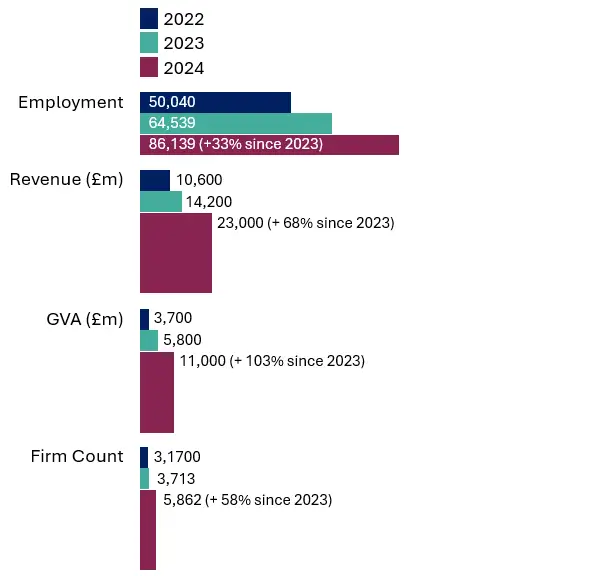
The UK is the third-largest AI market globally, valued at over £72 billion in 2024. The sector includes more than 5,800 companies and employs over 86,000 people, with widespread adoption across industries such as defence, healthcare, and financial services. Recent investment announcements by US tech firms such as Microsoft and Nvidia highlight the UK’s growing role as a hub for AI infrastructure and innovation.
Government policy has focused on enabling growth and responsible deployment. The AI Opportunities Action Plan outlines measures to support public sector adoption, attract international talent, and strengthen sovereign capabilities. The Compute Roadmap commits £2 billion to build a national computing ecosystem. Funding programmes such as BridgeAI and the UKRI Technology Missions Fund are supporting proof-of-concept projects and sector-specific innovation, with £7 million awarded to 120 AI projects in early 2025.
These initiatives, alongside international partnerships and a pro-innovation regulatory stance, are creating new opportunities for businesses and researchers including from New Zealand — particularly in areas like agriculture and agri-tech, healthcare and life sciences, advanced manufacturing, financial services, energy and climate tech, transport and mobility, defence and security, public sector and government services, and creative industries.
Report
The UK ranks as the third largest artificial intelligence (AI) market globally, following the US and China, and was valued at over £72 billion in 2024[i]. The country is home to over 5,800 AI companies employing over 86,000 people, a 34% increase year-on-year[ii]. According to the UK government’s 2024 AI sector study, the sector generated £23.9 billion in revenue and contributed £11.8 billion in gross value added (GVA)[iii].
AI sector study headline metrics (2022 – 2024)
UK companies are adopting AI across a broad range of sectors, including agriculture and agri-tech, healthcare and life sciences, advanced manufacturing, financial services, energy and climate tech, transport and mobility, defence and security, public sector and government services, and creative industries[iv]. These include companies offering AI products and services in addition to those using AI as part of a broader business offering. High profile UK-based companies offering AI products include:
- AI research and development company Google Deepmind;
- cybersecurity company Darktrace[v]; and
- autonomous vehicle developer Wayve (founded by New Zealander Alex Kendall).
In addition, major technology companies including Microsoft, Nvidia, Amazon, Meta and OpenAI have a substantial presence in the UK[vi].
In an announcement timed to coincide with US President Trump’s visit in September 2025, US tech firms pledged over £30 billion of investment in AI infrastructure in the UK.
This included a £22 billion commitment from Microsoft to build a large supercomputer and other infrastructure. Nvidia also pledged to invest £11 billion to set up AI factories in the country, signalling the UK would be on track to host Europe’s largest deployment of GPUs. These announcements follow AI commitments of £25 billion and £14 billion made at the UK’s International Investment Summit in October 2024, and in line with the release of the government’s AI Action Plan in January 2025 respectively[vii].
Policy and regulatory settings
The UK has positioned itself as a global leader in AI and is looking to invest in both the economic opportunities presented by AI technologies and their responsible deployment. In January 2025, the UK government published its AI Opportunities Action Plan, which examines how the UK can grow its AI sector and encourage AI uptake in public services. The Plan has three pillars:
- “Lay the Foundations to Enable AI” which focuses on growth zones, compute, datasets, and skills;
- “Change Lives by Embracing AI” focusing on AI adoption with a new approach of ‘scan-pilot-scale’; and
- “Secure the Future with Homegrown AI”, intended to strengthen the UK’s sovereign AI capabilities[viii].
The Plan included 50 recommendations and commitments. These include:
- Delivering the first AI Growth Zone and development of a process to identify and select further Growth Zones (designated areas where planning processes are streamlined and access to necessary infrastructure is facilitated to attract investment from AI companies).
- Establishing a new AI scholarship scheme by autumn 2026 and expanding UK Research Institute AI Fellowship programmes by 2026/27.
- Setting out how the UK will attract highly skilled AI workers from abroad with internationally competitive visas, including for talent to join UK-based organisations or to start their own business.
- Addressing private-sector-user adoption barriers as part of the Industrial Strategy development and identifying opportunities for AI adoption in key industries[ix].
Following the launching of the AI Opportunities Action Plan, the UK has taken several further steps, including the launch of a Compute Roadmap in July 2025 which commits up to £2 billion to 2030 to build a computing ecosystem, building on the delivery of two new AI supercomputers. The Roadmap pledges to support British companies to develop sustainable and secure compute technologies.
International Partnerships
International partnerships are a key part of the UK’s approach to AI. The AI Opportunities Action Plan highlights the importance of international compute partnerships with likeminded countries and the Compute Roadmap states that the UK is exploring partnerships with like-minded countries and computing centres, and emphasises that international collaboration is essential to remaining at the forefront of AI and tackling shared challenges. The UK’s membership of EU initiatives like Horizon Europe and recent collaborations with Canada and France are specifically referenced, but the Roadmap also states that the UK will seek to deepen ties with countries that share its values and ambition.
In 2023, the UK hosted the world’s first AI Safety Summit and launched the AI Security Institute within the Department for Science, Innovation and Technology (DSIT). The Institute conducts research on the security risks of advanced AI and develops and tests mitigations. The UK has invested £100 million in AI research including, but not limited to, research on AI security[xii].
The UK government has stated that it has a pro-innovation approach to AI regulation[xiii], and there are currently no formal AI regulations. However, a range of other laws, including privacy and copyright laws, govern aspects of AI-related issues, such as the use of personal data and intellectual property[xiv].
Funding
Innovate UK funds British businesses and research organisations to undertake AI proof-of-concept projects through its ‘Bridge AI’ programme to drive the adoption of AI technologies across the UK economy[xv]. A 2025 Bridge AI funding round awarded up to £200,000 to UK registered organisations[xvi]. The Compute Roadmap articulates an ambition to pull through the most successful UK-developed technologies into the commercial, at-scale deployments of AI Growth Zones, and to use Sovereign AI to support the acceleration of promising technologies.
In January 2025, £7 million in funding was awarded by the UK Research and Innovation (UKRI) Technology Missions Fund, focused on 120 projects in high growth industry sectors including agri-food, transport and logistics, construction, and creative industries[xvii].
Opportunities for New Zealand
New Zealand similarly intends to use AI to grow the economy and improve public services[xviii]. In July 2025, the New Zealand government published an AI strategy. The strategy encourages adoption of AI to boost productivity and economic growth[xix]. In January the Government also published the Public Service AI Framework to support government agencies in their use of AI. The NZ Institute for Advanced Technology has also put out a call for AI proposals for the Artificial Intelligence Research Platform(external link).
The UK’s increasing focus on AI provides opportunities for New Zealand businesses and researchers. In particular, the Compute Roadmap states that the UK Government will work with researchers, start-ups, industry and international partners, and underlines that “international collaboration is essential to tackling shared challenges, particularly in areas like security, resilience, and sustainability” (p. 15)
The UK’s AI for Science Strategy includes missions for accelerating drug discovery and developing autonomous labs. NZ researchers may consider joining consortia applying for UKRI or Horizon Europe funding – both New Zealand and the United Kingdom are part of Horizon Europe (read about the recent NZ AI and Data delegation to UK and Europe(external link), supported by MBIE). Researchers interested in applying for Horizon Europe should begin by visiting the Horizon Europe Research Fund webpage(external link) hosted by the Ministry of Business, Innovation, and Employment
External links
- Great.gov.uk - Artificial Intelligence(external link)
- AI Opportunities Action Plan - GOV.UK(external link)
- Artificial Intelligence sector study 2024(external link)
- Compute Roadmap(external link)
[i] AI Opportunities Action Plan - GOV.UK(external link)
[ii] Artificial Intelligence sector study 2024 - GOV.UK(external link)
[iii] Science and technology’s contribution to the UK economy - House of Lords Library(external link)
[iv] Artificial Intelligence sector study 2023 - GOV.UK(external link)
[v] Artificial Intelligence sector study 2023 - GOV.UK(external link)
[vi] Artificial Intelligence sector study 2023 - GOV.UK(external link)
[viii] AI Opportunities Action Plan - GOV.UK(external link)
[ix] AI Opportunities Action Plan - GOV.UK(external link)
[xi] AI Security Institute - GOV.UK(external link)
[xii] Artificial Intelligence(external link)
[xiii] A pro-innovation approach to AI regulation: government response - GOV.UK(external link)
[xiv] Artificial intelligence: ethics, governance and regulation - POSTs(external link)
[xv] BridgeAI - Innovate UK Business Connect(external link)
[xvi] BridgeAI Innovation Exchange: Empowering AI Innovation - Innovate UK Business Connect(external link)
[xvii] Over £7 million awarded to help AI boost growth in the UK – UKRI(external link)
[xviii] Guidance for safe use of AI in the public sector | Beehive.govt.nz(external link)
[xix] Q2 plan continues relentless focus on growth | Beehive.govt.nz(external link)
More reports
View full list of market reports
If you would like to request a topic for reporting please email exports@mfat.govt.nz
Sign up for email alerts
To get email alerts when new reports are published, go to our subscription page(external link)
Learn more about exporting to this market
New Zealand Trade & Enterprise’s comprehensive market guides(external link) export regulations, business culture, market-entry strategies and more.
Disclaimer
This information released in this report aligns with the provisions of the Official Information Act 1982. The opinions and analysis expressed in this report are the author’s own and do not necessarily reflect the views or official policy position of the New Zealand Government. The Ministry of Foreign Affairs and Trade and the New Zealand Government take no responsibility for the accuracy of this report.
Copyright
Crown copyright ©. Website copyright statement is licensed under the Creative Commons Attribution 4.0 International licence(external link). In essence, you are free to copy, distribute and adapt the work, as long as you attribute the work to the Crown and abide by the other licence terms.